Why birds, anyways?
We all know and (hopefully) love birds. But why do birds matter anyways?
In this very first bird • curious blog post, I share my takes on why everyone should be paying attention to our feathered friends.
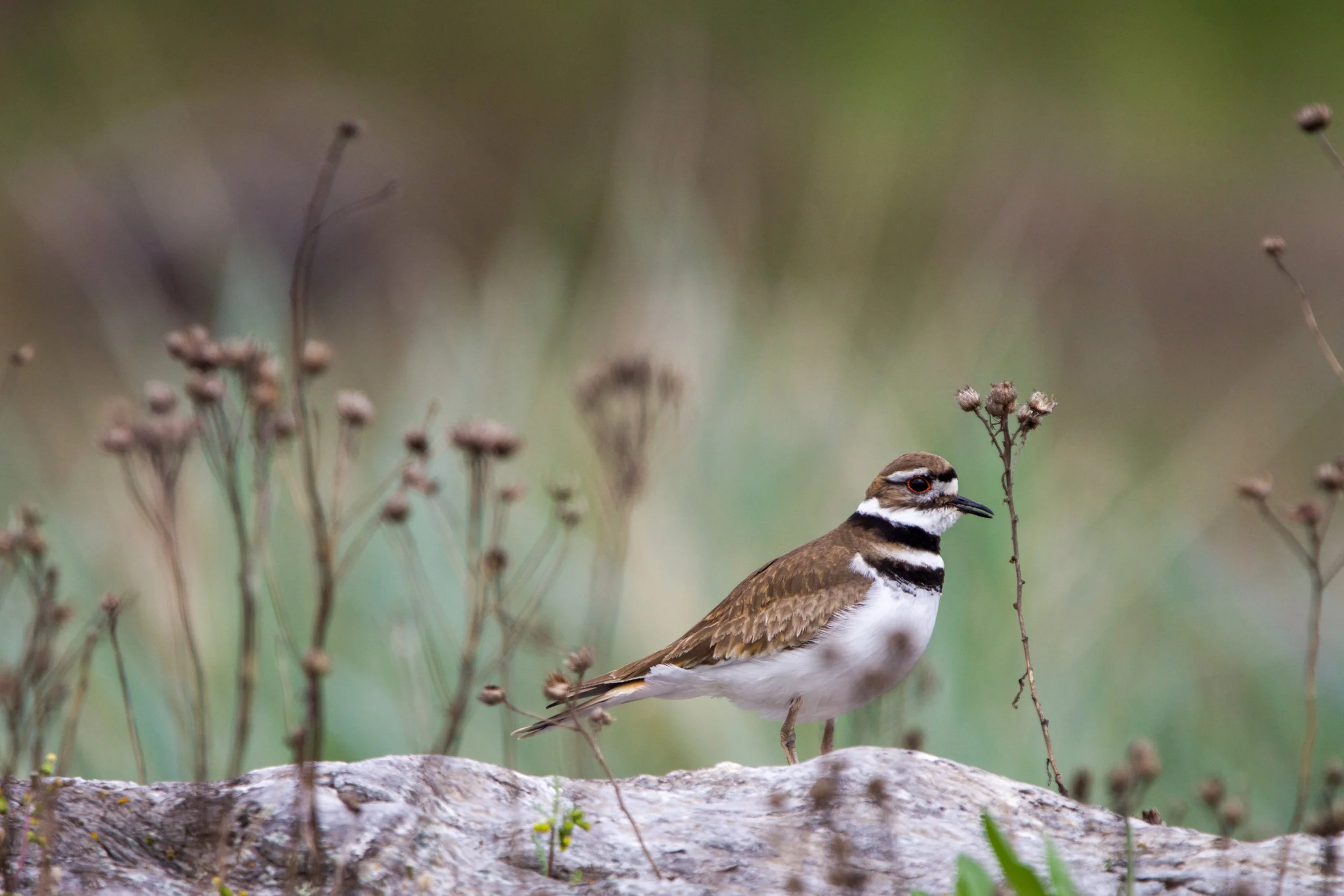
“Each bird is surprising and thrilling in its own way.”
-Amy Tan
Photo by Alex Roy
Birds as Bridges
I bet if you asked any person in the world to tell you about a notable experience they’ve had with a bird, they would be able to think of one. Even if it was an unfortunate encounter with a voracious gull stealing a french fry or a screaming crow perched a little too close to their window a little too early in the morning.
Birds connect us all. They are found on every continent in the world; in cities, forests, prairies, mountains, artic islands, and deserts.
Birds know no borders. Some travel thousands of kilometers and through several countries each year.
Let me paint you a picture. It is mid-February; I am on vacation in Costa Rica sitting by a garden filled with tropical plants like hibiscus, lobster claw, and verbena. Suddenly, a tiny grey bird appears in the purple flowers of the verbena, hopping branch to branch. With certain clues, I am able to identify it as a non-breeding male Chestnut-sided Warbler. Pretty soon, this bird will leave Central America to fly north for breeding season.
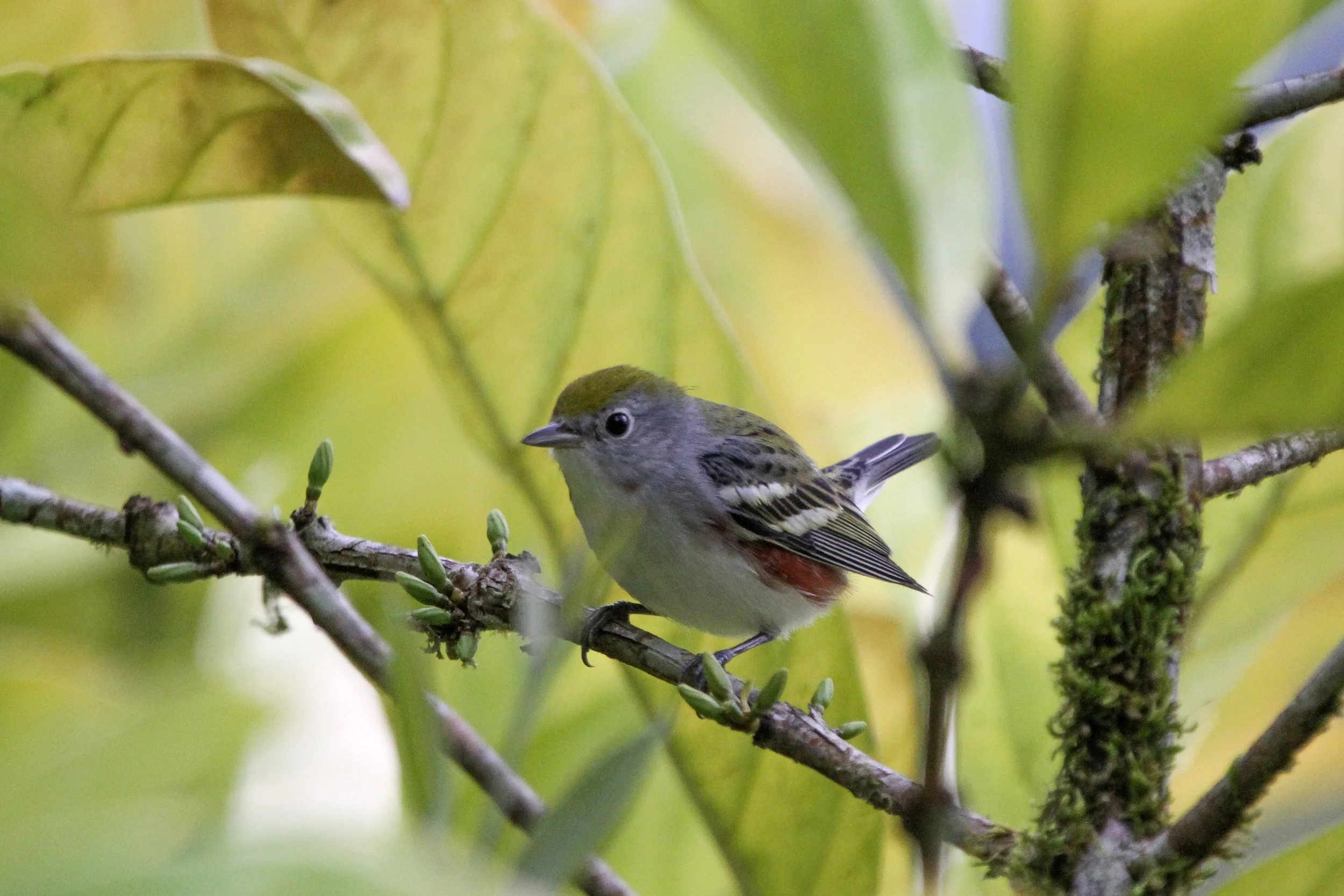
Non-breeding male Chestnut-sided Warbler. Photo by Alex Roy
To me, this is a familiar northern bird in a foreign place. In reality, this bird spends a great deal of the year in Central America during the non-breeding season, from late fall to early spring.
Come spring, this bird will make its way to eastern Canada and northeastern United States to nest in shrubby regenerative forests. Some birds are able to make the many-thousand-kilometer trip in one go, but many will make stops along the way.
Many warblers like the Chestnut-sided travel from Central America to northern North America where there is more space to nest and food availability for breeding season. That means that this particular warbler may stop in a backyard in Texas or Missouri, for example, before landing in, say, northwestern Ontario.
This bird is weaving an invisible line between thousands of kilometers, and an unknown number of people who may have stopped to admire its beauty and tenacity. Birds connect us all. Birds know no borders.
Fun Fact!
The Blackpoll Warbler is one of the warbler species with the longest migration route. They travel from northern South America to northern Canada and even as far as Alaska. Incredible, right? Now, listen to this! Scientists have confirmed using tiny geolocator backpacks, that on their journey back south in the fall, Blackpoll Warblers fly non-stop from the Eastern Seaboard; over the Atlantic Ocean, to South America. A non-stop transoceanic flight up to three days and 2,700 km long!
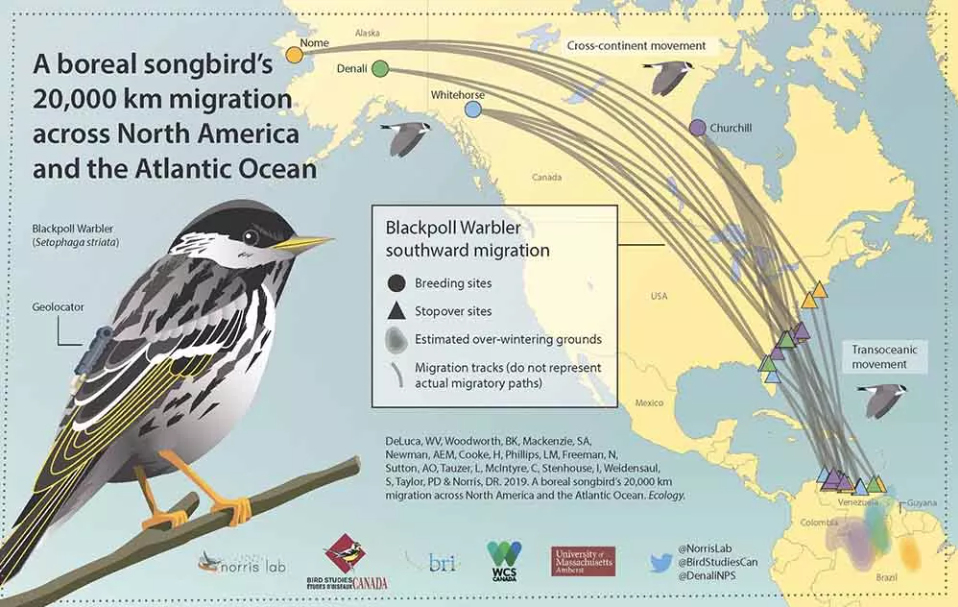
DeLuca et al deployed tiny geolocation devices with a 12-month battery life on male blackpoll warblers at four locations: Churchill, Manitoba; Whitehorse, Yukon Territory; Denali National Park and Nome, both in Alaska. UMass Amherst / University of Guelph, published in Science News on March 19, 2019.
Environmental Indicators & Caretakers
Birds provide many environmental “services”. They pollinate plants, disperse seeds, and control insect populations, to name a few. Some birds like vultures even act like an environmental clean-up crew, eating carcasses of dead animals.
Birds are intricately connected with the environments they’re adapted to. They can also tell humans a lot about the environment.
Have you ever heard the term “canary in a coal mine”? Historically, canaries were used in mines to detect dangers such as carbon monoxide; when the birds became ill or died, the workers would know they were in danger.
Birds still have the capacity to warn us when there are changes in the environment. They are very sensitive to environmental changes such as a change in availability of food (i.e., insects), temperature shifts, and rising water levels.
Thanks to dedicated birders, community science programs such as eBird, and Traditional Ecological Knowledge, we know a lot about the patterns of bird migration and movement and can detect changes relatively well. We can learn a lot by looking at the status and health of bird populations. Unfortunately, many are not doing so well.
“Birds are excellent environmental indicators–they are nature’s sentinels. Studying birds allows us to understand the overall health of our ecosystems and the environment.”
- from Birds Canada
At Risk
It is known that we are currently facing dual crises of rapid biodiversity loss and climate change. Birds, like a frighteningly high number of other animals, are facing severe threats to survival.
In North America, about 30% of bird populations have been lost since 1970, totaling nearly 3 billion birds.
While some populations are stable and even increasing in numbers, many are declining rapidly, such as aerial insectivores (birds that eat bugs while in flight), shorebirds, and grassland birds.
According to Birds Canada, the greatest threats to birds in Canada are:
Habitat Loss
Pesticides and Contaminants
Invasive Species and Feral Cats
Collisions
Climate Crisis
You may not be surprised to see that all of the threats to birds in Canada are anthropological, or in simple terms, human caused.
There is a lot to say about these threats and what we can each do to help mitigate them, such as keeping your cats indoors and limiting the use of pesticides. We all have a responsibility to live in a way that protects vulnerable groups such as birds. I will dive into how we can live more bird-friendly lives in future blogs.
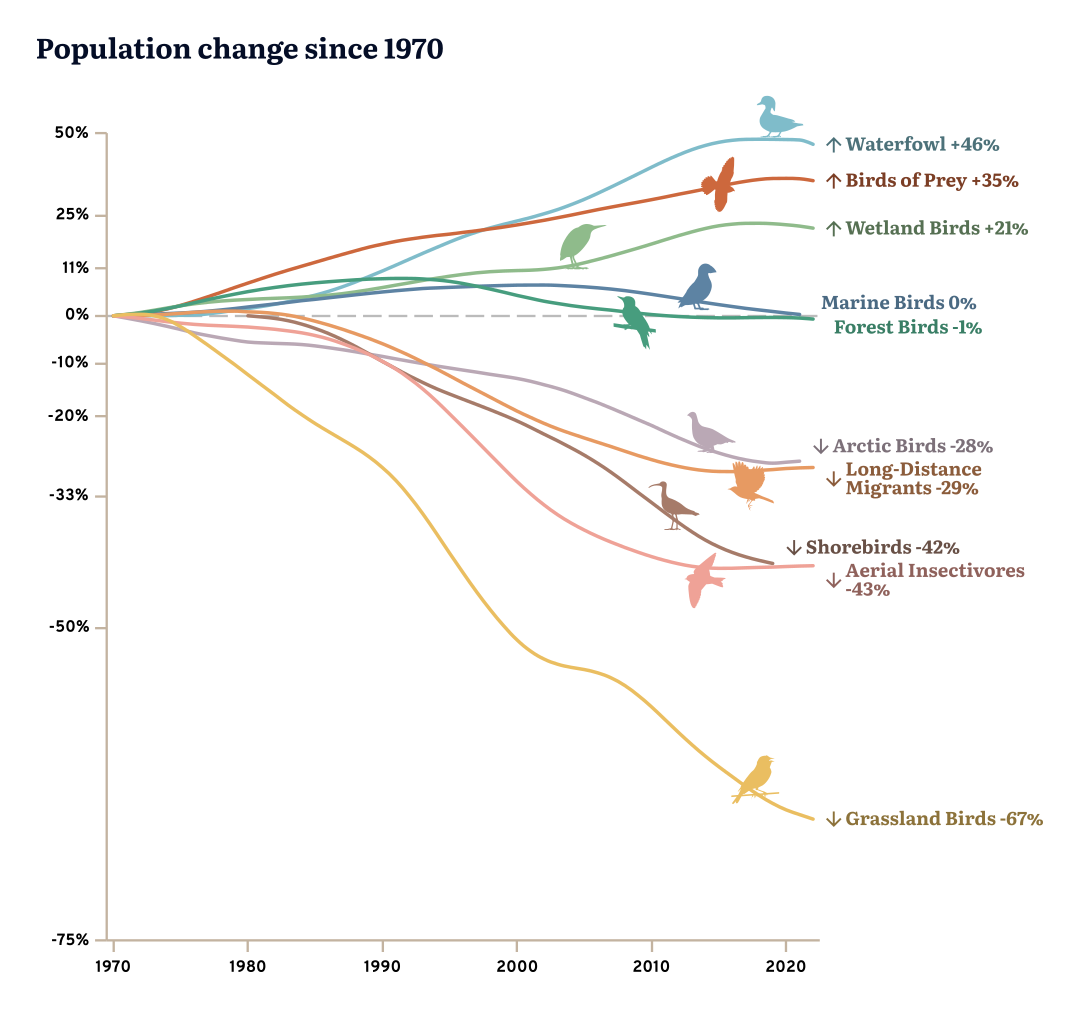
Graph taken from the State of Canada’s Birds 2024 report created by Environment and Climate Change Canada and Birds Canada. Recovery programs and wetland conservation has resulted in the increase of waterfowl and birds of prey, while many other bird groups are significantly declining, such as shorebirds, aerial insectivores (swallows, swifts), and grassland birds.
Our Well-being
In a time where we are all-too-often ill from stress about work, the climate crisis, grocery prices, or a myriad of other horrors of late-stage capitalism, we can all use some healing through the wonders and beauty of nature.
Lucky for us, we live on a planet where birds exist!
There is certainly no shortage of wonder or beauty in the world of birds. All it takes is a bit of attention to realize that birds are all around us, living remarkable lives right under our noses!
Modern western society’s physical and spiritual disconnection from the environment is a wound that needs healing.
For many of us folks in the west, our societal systems do not align with our natural connection to the environment that sustains us.
Birds allows us to connect to the environment, no matter where we are. Even watching a pigeon carrying a stick to its nest under a concrete bridge can be a reminder of this connection.
For me, birding is often a meditative act where I can quiet my mind and focus only on the bird. Their sounds, movements, or tiny feathered details. During these moments I am simply another animal, but with the unique privilege to notice beauty and feel grateful. This experience is incredibly peaceful, like a deep wound is being healed.
There are now also many studies that show how birding benefits mental health. I am not surprised, nor do I necessarily need a research paper to validate this for me, but it is neat to see that science is confirming the positive impacts birding can have on our well-being.
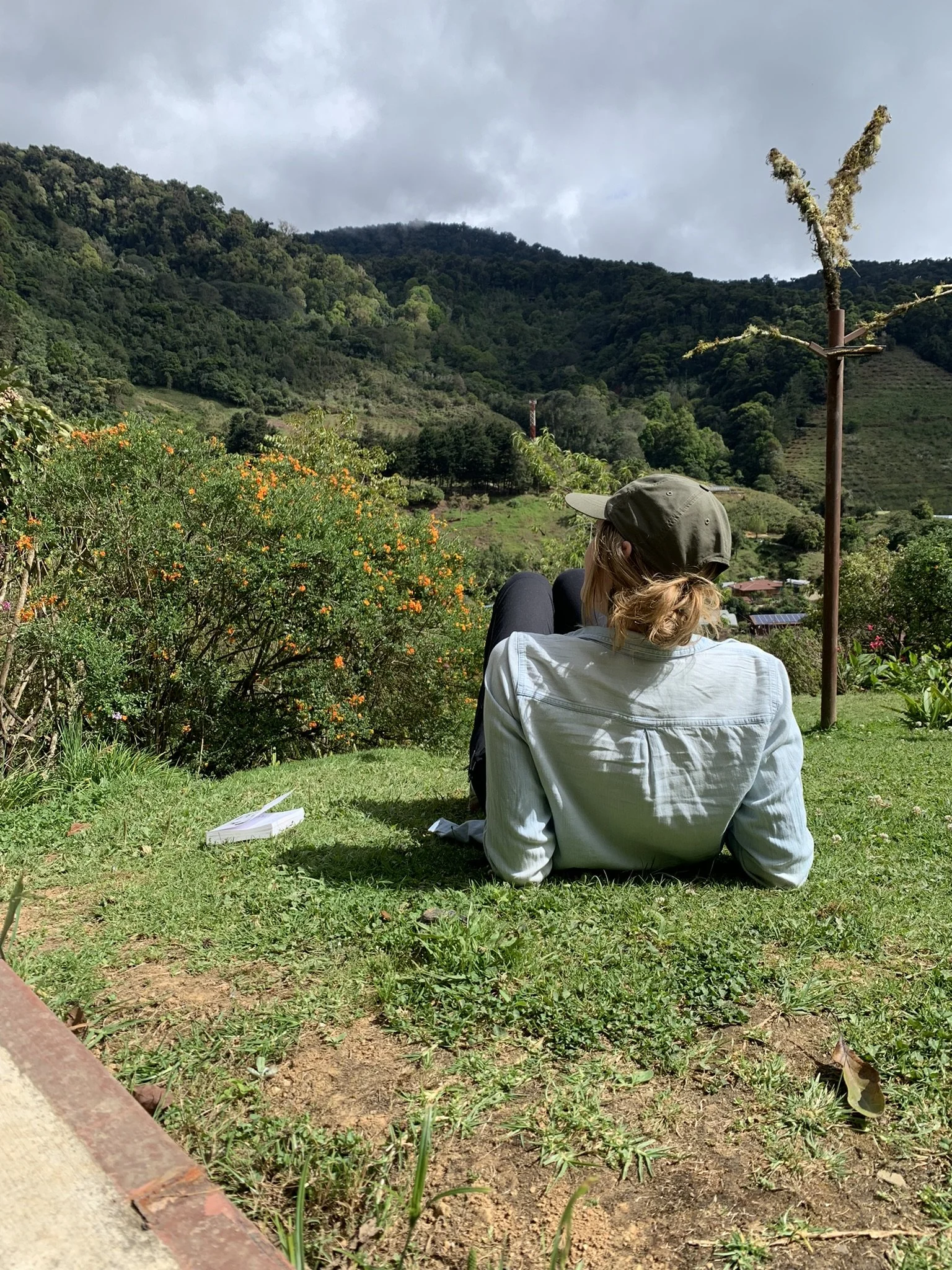
Enjoying the beauty and serenity of a Costa-Rican mountain valley filled with colourful flowers and birds.
Thank you for reading the first bird • curious blog!
I would encourage everyone reading to take a moment today or this week to watch and appreciate the birds around you.
Be warned.. birding is a slippery slope into all-encompassing passion and madness. Join me in it, would you ;)
I hope this has given you a taste of why birds are attention-worthy, and I would argue, obsession-worthy. I can’t wait to share more about the awe-inspiring lives of birds as we move forward.
until next time,
xo Kristen